#6¾ Envelope Size: Dimensions, Uses and How to Print One
The #6¾ is the small envelope people mail checks and bill payments in: 6½ in long and 3⅝ in high. Here’s what fits inside, how it compares with its bigger siblings, and how to print the address on one at home.
Updated 9 min readBy the Envelope10 team
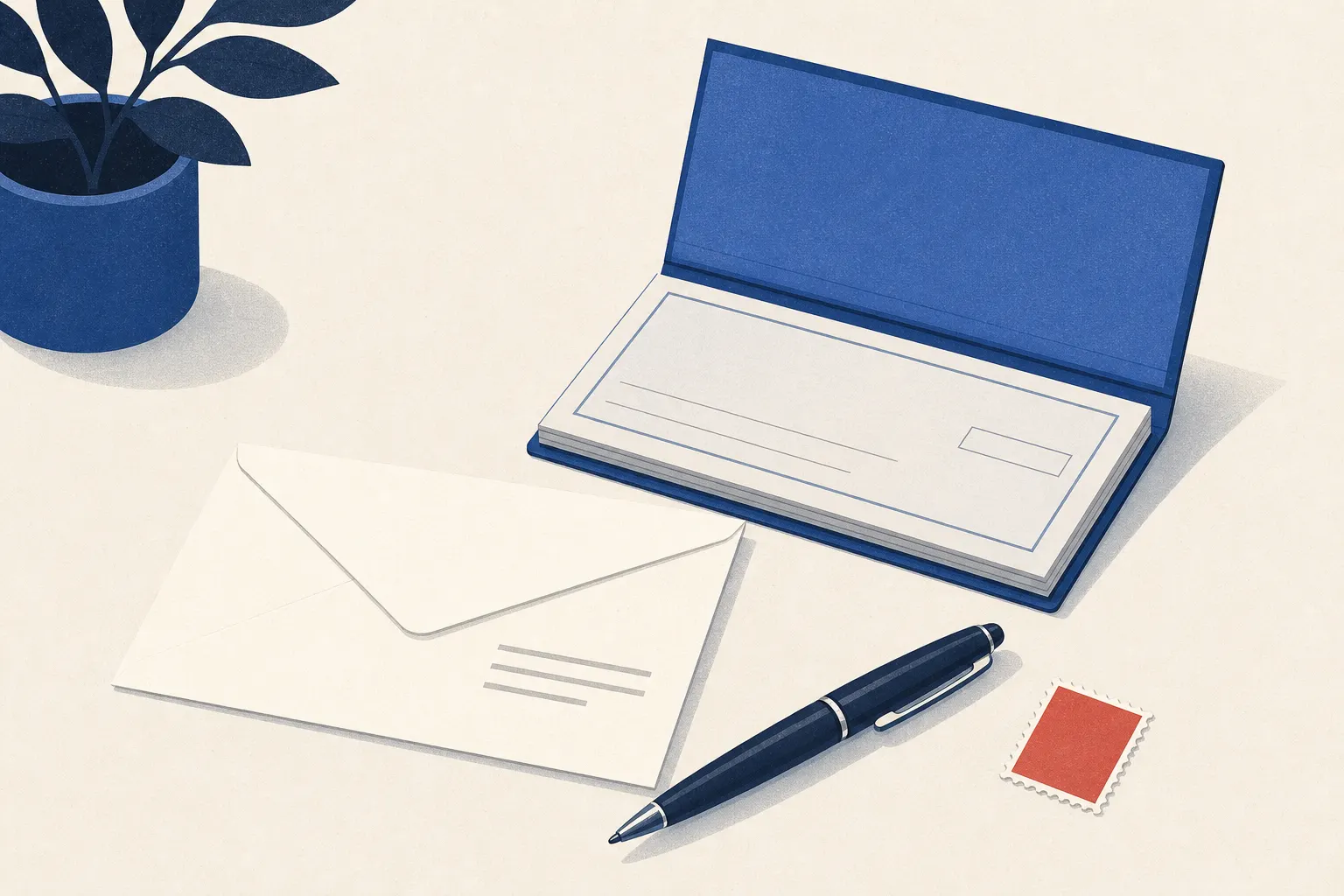
A #6¾ envelope measures 3⅝ × 6½ in (about 92 × 165 mm). It’s the compact member of the numbered business-envelope family, sized for personal checks, bill payments and short notes, and it mails as an ordinary letter: one Forever stamp covers it up to 1 oz.
You’ll see the name written several ways: #6¾, 6 3/4, 6-3/4, #6.75 or No. 6¾. They all mean the same envelope. This guide covers its exact dimensions, what fits inside, how it compares with the #9 and #10, and what changes when you print an address on an envelope this short.
#6¾ envelope dimensions
USPS lists the #6¾ at 3⅝ × 6½ in on the order form for its Personalized Stamped Envelopes (PS Form 3203-X). Envelope boxes follow the same convention and put the height first. Print dialogs and design apps usually want the long side first, as width × height, because the envelope prints in landscape.
| Unit | Length × height | Where you’ll need it |
|---|---|---|
| Inches (decimal) | 6.5 × 3.625 | Print dialogs, custom paper sizes |
| Inches (fractions) | 6½ × 3⅝ | Envelope boxes, USPS forms |
| Millimeters | 165.1 × 92.1 | Metric printer drivers, LibreOffice |
| Centimeters | 16.5 × 9.2 | Quick reference |
| Points (1/72 in) | 468 × 261 | PDF tools, InDesign, Illustrator |
| Pixels at 300 dpi | 1950 × 1088 | Canva, Photoshop, print-quality images |
| Aspect ratio | 1.79 : 1 | USPS machinability check |
Windows keeps its own list of standard paper sizes, and there the 3⅝ × 6½ in envelope is the “6 3/4 Envelope,” filed under the internal name for a personal envelope (Microsoft’s paper-size list). Many printer drivers show it as Envelope #6 3/4 or 6 3/4 Envelope.
One more number worth knowing: the smallest letter USPS accepts is 5 in long and 3½ in high (DMM 101.1.1). At 3⅝ in, a #6¾ clears that minimum by just ⅛ in. That’s fine for mailing, but it explains why everything on this envelope feels a little cramped.
What a #6¾ envelope is for
The #6¾ is a utility envelope. It’s big enough for a check and a payment slip, and small enough to keep a stack in a desk drawer. Its typical jobs:
- Bill payments. A check and the stub from a bill, mailed to a company’s payment address. This is the classic remittance envelope.
- Personal checks. Rent, a deposit, a gift or a donation, with or without a short note.
- Personal correspondence. A short note or a letter folded small, when a long #10 feels too formal.
- Small business mail. Receipts, small statements and other slips that don’t need a full-size envelope.
That’s why the Envelope10 printer labels the size “Checks and bill payments.” If you’re mailing a full letter, a #10 is the better fit.
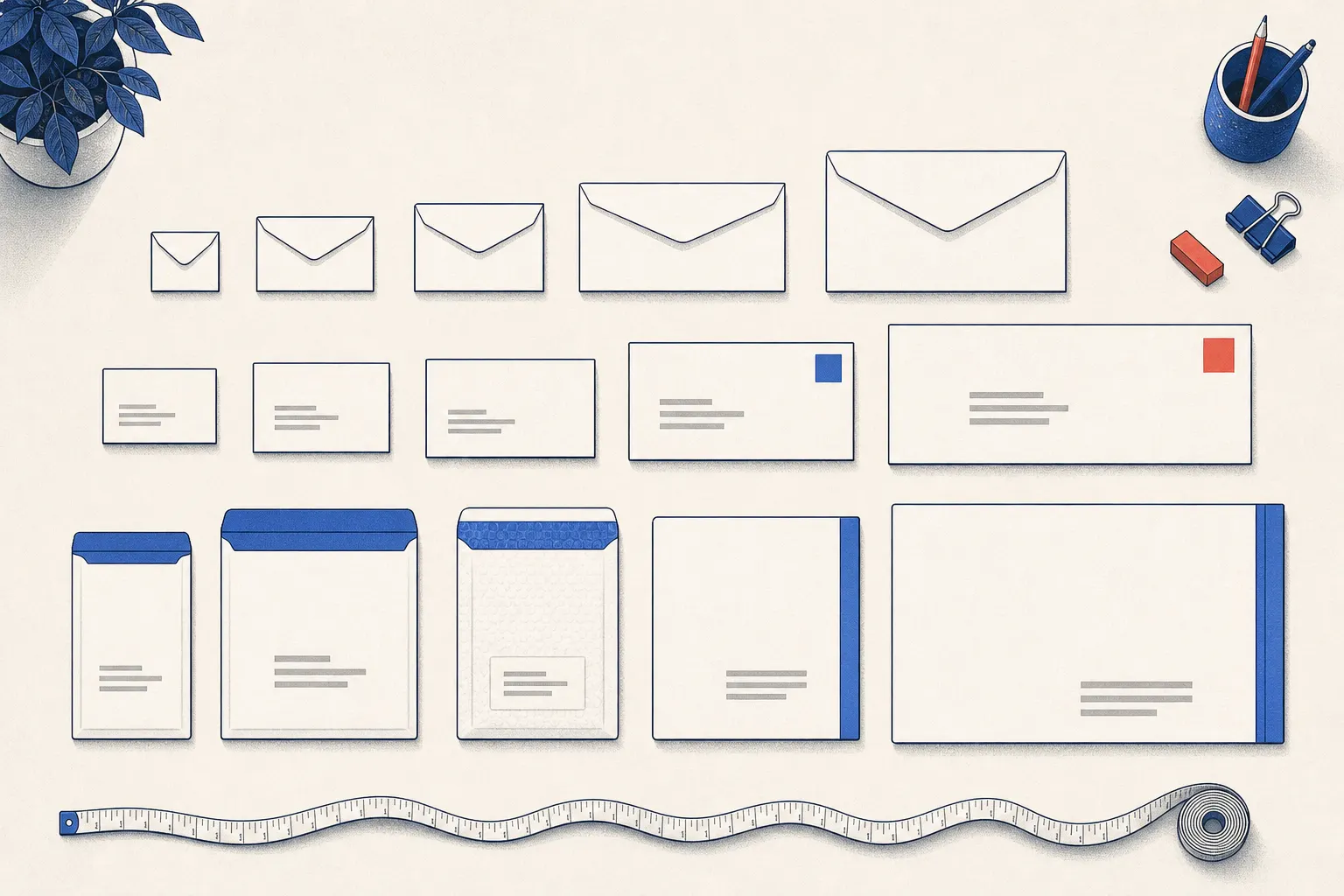
#6¾ vs. #9 vs. #10
The three sizes nest. A #6¾ is 2⅜ in shorter and ¼ in lower than a #9, and 3 in shorter and ½ in lower than a #10, so it slides inside either one. That makes it usable as a return envelope inside a larger mailing, the same way a #9 rides inside a #10.
| #6¾ | #9 | #10 | |
|---|---|---|---|
| Size (height × length) | 3⅝ × 6½ in | 3⅞ × 8⅞ in | 4⅛ × 9½ in |
| Aspect ratio | 1.79 | 2.29 | 2.30 |
| Typical use | Checks, bill payments, notes | Reply envelopes, letters | Business letters, invoices |
| A letter sheet fits | Folded in half, then in thirds | Folded in thirds (snug) | Folded in thirds, with room |
| Delivery address in Envelope10 starts | 1.9 in from the left | 3.75 in from the left | 4 in from the left |
| Print-dialog paper size | Envelope #6 3/4, or custom 6.5 × 3.625 in | Envelope #9, or custom 8.875 × 3.875 in | Envelope #10 / Com-10 |
If a #6¾ turns out slightly too small, the next standard sizes up are the #7 (3¾ × 6¾ in) and the Monarch (3⅞ × 7½ in). Envelope10 doesn’t print those two; our envelope sizes chart lists them alongside every other common size. For the larger neighbors, see the #9 envelope size guide and the #10 envelope size guide.
What fits in a #6¾ envelope
A personal check goes in flat, which is the whole point of the size. Paper is where people get caught out, because the order of the folds matters. Here is the arithmetic for common sheets, compared with the envelope’s outside size of 6½ × 3⅝ in:
| Contents | Folded size | Fits? |
|---|---|---|
| Personal check | Flat | Yes |
| Letter (8½ × 11 in), folded in half, then in thirds | About 5½ × 2⅚ in | Yes, about 1 in and ¾ in to spare |
| Half-letter sheet (5½ × 8½ in), folded in thirds | About 5½ × 2⅚ in | Yes |
| Letter folded in thirds, then in half | About 4¼ × 3⅔ in | No, a hair taller than the envelope |
| Letter folded in quarters | 4¼ × 5½ in | No, too tall |
| 4 × 6 in photo or postcard | Flat | No, 4 in is taller than 3⅝ in |
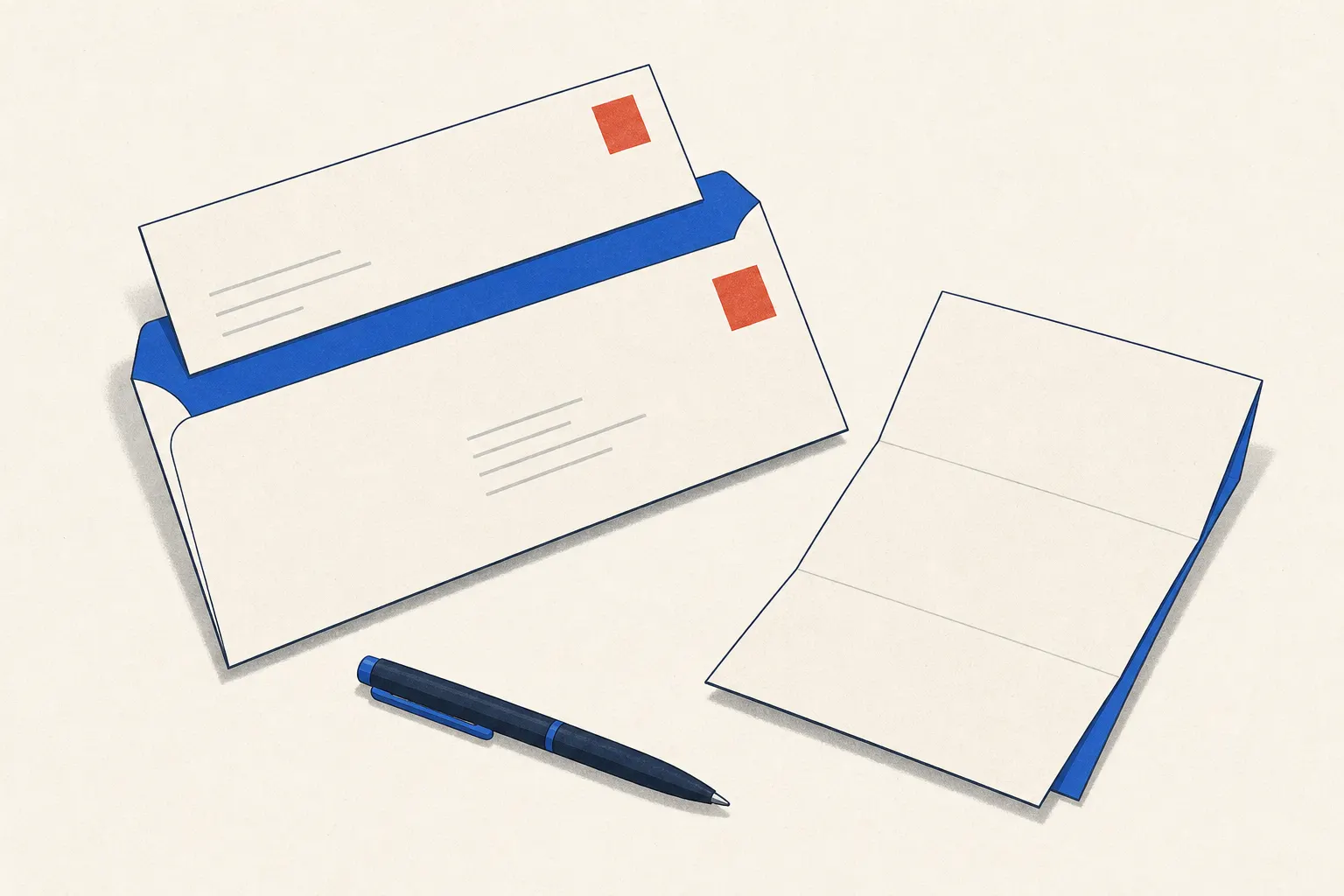
The business-letter fold, in thirds, leaves a packet 3⅔ in tall, about 1/24 in taller than the outside of a #6¾, and folding it in half afterwards doesn’t change that. Fold in half first, then in thirds. A letter folded in quarters suits an A2 envelope instead.
The short envelope and the USPS zones
USPS measures its address zones from the bottom and right edges of a letter, whatever its size (DMM 202). The delivery address belongs in the OCR read area, between ⅝ in and 2¾ in above the bottom edge and at least ½ in from each side. Below it, a strip 4¾ in long and ⅝ in tall in the lower right is the barcode clear zone, where sorting machines print their barcode. It has to stay empty.
On a 9½ in #10, that strip takes half the bottom edge. On a 6½ in #6¾ it takes 4¾ in, nearly three-quarters of it, and leaves only 1¾ in at the bottom left. Height is tight too: the read area tops out 2¾ in above the bottom, just ⅞ in below the top edge of a 3⅝ in envelope. The return address and the stamp have to fit in that top strip without crowding the delivery block.
Here’s how Envelope10 lays out a #6¾. The delivery block starts 1.9 in from the left edge and about 1.55 in from the top, which puts it below the stamp, inside the read area and above the barcode strip. That leaves about 4.1 in for the longest line before the ½ in right margin. The 10 pt return address starts 0.35 in from the top with tighter line spacing than on a #10, so even four lines end above the read area.
If you lay out a #6¾ yourself in a word processor, don’t copy the delivery-address position from a #10 template. A block placed 4 in from the left of a 6½ in envelope leaves only 2 in for each line. For the full set of rules, see our guide to USPS address placement rules.
Printing a #6¾ envelope at home
The steps are the same as for any envelope. The only differences are the paper size you pick and whether your printer can feed something this small.
- Open the printer with #6¾ selected. The Envelope10 #6¾ printer opens with the size already picked.
- Enter both addresses. Both are required: name, street, city, state and ZIP, with an optional apartment or suite line. For a bill payment, the delivery address is the payment address printed on the bill, which may differ from the company’s office address.
- Check the live preview. Turn on the USPS zones to confirm the longest line stays clear of the right margin.
- Open or download the PDF. The page is exactly 6.5 × 3.625 in, landscape.
- Pick the paper size. In the print dialog, choose Envelope #6 3/4 (some drivers call it 6 3/4 Envelope). If it isn’t listed, add a custom size of 6.5 × 3.625 in. Set the scale to 100% or Actual size.
- Test, then print. Print once on plain paper, lay an envelope over the sheet and hold both up to the light. If the text lines up, feed the envelope the same way.
Check your printer’s minimum paper size
Every printer has a smallest sheet it can feed, usually listed in its specifications as the minimum media size or custom paper size range. A #6¾ is only 3⅝ in on its short side, so look that number up before you buy a box. If the main tray can’t take it, check whether a rear tray or manual feed slot accepts smaller media.
Which way the envelope goes in depends on the printer: face up or face down, flap left or right. Our guide to loading envelopes in HP, Canon, Epson and Brother printers shows how to work out your printer’s orientation with one sheet of paper.
Postage for a #6¾ envelope
A #6¾ is a letter in USPS terms. It’s inside the size limits for letter mail, and its aspect ratio (length divided by height) is 1.79, well within the 1.3 to 2.5 range sorting machines handle (DMM 101). A flat, flexible #6¾ up to 1 oz mails for one Forever stamp.
| Weight | Stamped price |
|---|---|
| Up to 1 oz | $0.82 |
| Up to 2 oz | $1.11 |
| Up to 3 oz | $1.40 |
| Up to 3.5 oz | $1.69 |
| Nonmachinable surcharge | +$0.49 |
Businesses that use a postage meter pay $0.78 for a 1-oz letter instead of $0.82 (Notice 123). The surcharge applies when a letter can’t run through the machines: a coin or key that makes it lumpy, stiff contents that make it rigid, or an address written parallel to the short side. A check and a payment slip trigger none of those.
Mailing a payment soon? The #6¾ envelope printer handles the layout, and if you need a different size, the envelope sizes chart helps you pick one.
Frequently asked questions
What size is a 6 3/4 envelope?
A #6 3/4 envelope measures 3 5/8 x 6 1/2 inches, or about 92 x 165 mm. When a print dialog or design app asks for width and height, enter 6.5 x 3.625 in, landscape.
What is a 6 3/4 envelope used for?
Mostly for mailing personal checks, bill payments and remittance slips, plus short personal notes. It is the compact counterpart to the #10 business envelope.
Does a check fit in a 6 3/4 envelope?
Yes. A standard personal check goes in flat, which is why #6 3/4 is the usual size for mailing payments. A full letter sheet only fits if you fold it in half first and then in thirds.
Is a #6 3/4 the same as a personal envelope?
Often, yes. Windows' built-in list of paper sizes defines its personal envelope as the 6 3/4 envelope, 3 5/8 x 6 1/2 in. Stationers don't all use the term the same way, so check the dimensions on the box.
Can a home printer print on a 6 3/4 envelope?
Many can. Choose Envelope #6 3/4 as the paper size or create a custom 6.5 x 3.625 in size, print at 100% scale, and look up your printer's minimum media size in its specifications before you buy a box.
How many stamps does a 6 3/4 envelope need?
One Forever stamp, $0.82 as of July 12, 2026, covers a flat #6 3/4 letter up to 1 oz. Each extra ounce adds $0.29, and rigid or lumpy contents add a $0.49 nonmachinable surcharge.