Envelope Sizes Chart: Every Standard US Envelope Size
Envelope names come from several systems whose numbers don’t line up. This chart puts every standard US size in one place, with what fits inside and how each one mails.
Updated 10 min readBy the Envelope10 team
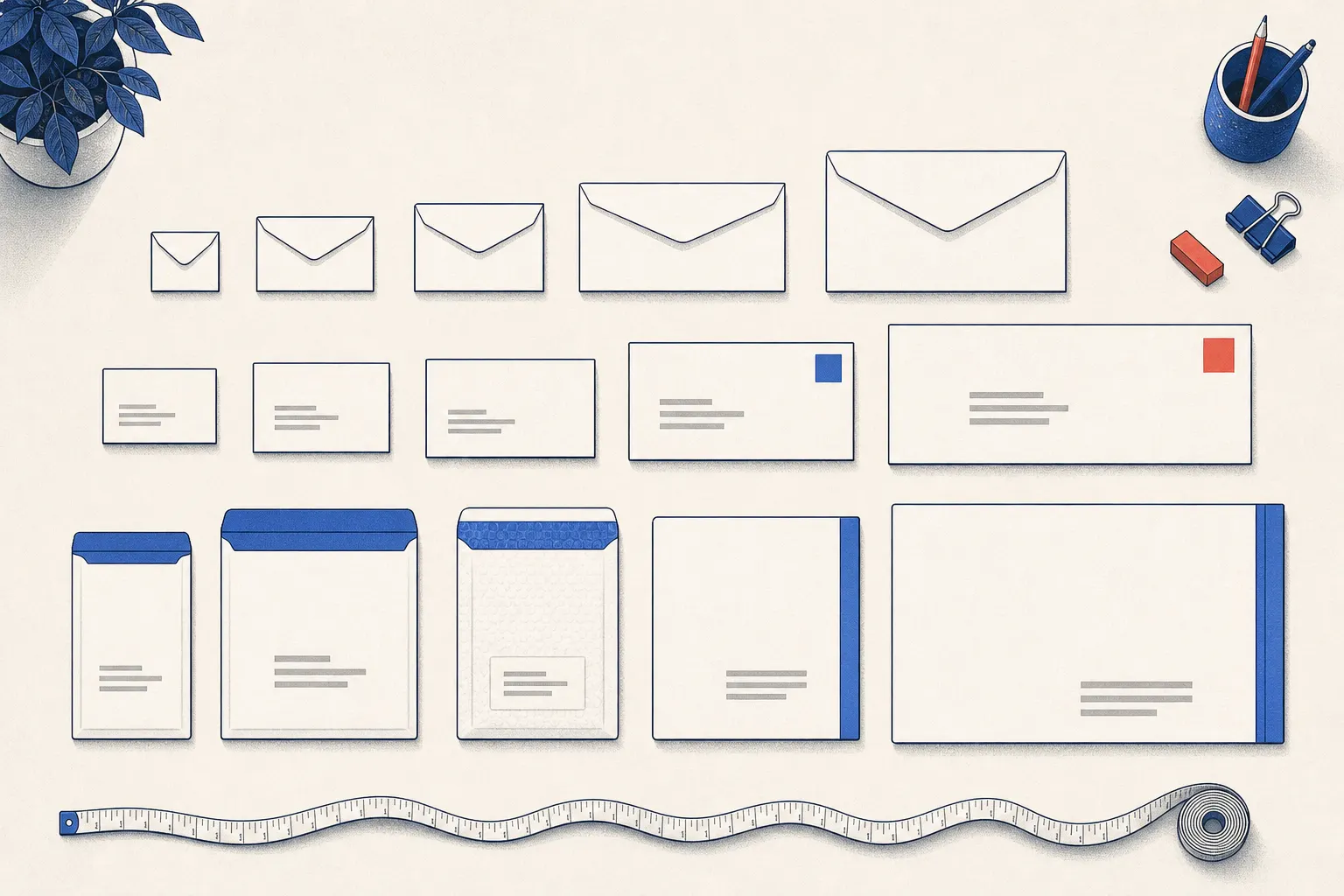
The most common US envelope sizes are the #10 (4⅛ × 9½ in) for business letters, the A7 (5¼ × 7¼ in) for 5 × 7 invitations, the A2 (4⅜ × 5¾ in) for 4¼ × 5½ note cards, and 6 × 9 or 9 × 12 catalog envelopes for documents you don’t want to fold. The charts below list every standard size with its dimensions, what fits inside and how the Postal Service prices it.
Sizes are given short side first, in inches and millimeters. They are the standard outside measurements; brands can differ slightly, so check the label on the box before you set up a print job.
The most common envelope sizes
If you only need the short version, these cover most household and office mail:
- #10, 4⅛ × 9½ in: the standard business envelope, sized for a letter folded in thirds. Bills, invoices, cover letters.
- #9, 3⅞ × 8⅞ in: the reply envelope tucked inside a #10.
- #6¾, 3⅝ × 6½ in: checks, bill payments and short personal notes.
- A7, 5¼ × 7¼ in: 5 × 7 invitations, announcements and greeting cards.
- A2, 4⅜ × 5¾ in: thank-you notes, RSVP cards and other 4¼ × 5½ cards.
- 6 × 9 and 9 × 12 in: documents, booklets and forms mailed flat.
Nearly everything else is a variation on these: a little bigger, a little smaller, or square.
How envelope sizes are named
Envelope names come from separate systems that grew up side by side, which is why an A10 is nothing like a #10. Once you know which family a name belongs to, the charts below make sense:
- Numbered business sizes. #6¼, #6¾, #9, #10, #14 and so on, also called commercial envelopes (hence “Com-10” in print dialogs). They’re long and low, for folded paper. The number is a trade name, not a measurement: nothing on a #10 measures 10 inches.
- A-series announcement sizes. A1 through A10, made to fit standard card sizes. Some have older names too: an A2 is also sold as a 5½ Baronial, and an A1 as a 4 Bar.
- Catalog and square sizes. Named after their dimensions: 6 × 9, 9 × 12, 6 × 6.
- International (ISO) sizes. DL, C6, C5 and C4, measured in millimeters and made to hold ISO paper such as A4, folded or flat.
Business envelope sizes chart
Business envelopes carry letters, bills and statements folded to fit. The three that Envelope10 prints link to their own guides and to the printer.
| Size | Inches | mm | Typical use | Print it |
|---|---|---|---|---|
| #6¼ | 3½ × 6 | 89 × 152 | Small personal and remittance envelopes | — |
| #6¾ | 3⅝ × 6½ | 92 × 165 | Checks, bill payments, personal notes | Print a #6¾ |
| #7 | 3¾ × 6¾ | 95 × 171 | Personal letters and remittance | — |
| Monarch (#7¾) | 3⅞ × 7½ | 98 × 191 | Executive-size personal stationery | — |
| #9 | 3⅞ × 8⅞ | 98 × 225 | Reply envelopes inside a #10 | Print a #9 |
| #10 | 4⅛ × 9½ | 105 × 241 | Business letters, bills, statements | Print a #10 |
| #11 | 4½ × 10⅜ | 114 × 264 | Larger business mail | — |
| #12 | 4¾ × 11 | 121 × 279 | Thicker folded documents | — |
| #14 | 5 × 11½ | 127 × 292 | Legal sheets folded in thirds, bulky mail | — |
The pair to remember is #9 and #10. A #9 is ¼ in lower and ⅝ in shorter, just enough to slide inside a #10 as the reply envelope. Monarch shares the #9’s 3⅞ in height but is 1⅜ in shorter; Windows lists it as Monarch Envelope, 3⅞ × 7½ in. For everything about the most common size, including its print-dialog names, see our #10 envelope size guide.
Invitation and card envelope sizes chart
A-series envelopes are squarer and are sold to match card sizes. The envelope usually runs about ¼ in larger than the card each way, enough to slide the card in without bending a corner.
| Size | Inches | mm | Card that fits | Print it |
|---|---|---|---|---|
| A1 (4 Bar) | 3⅝ × 5⅛ | 92 × 130 | Small RSVP and enclosure cards | — |
| A2 (5½ Baronial) | 4⅜ × 5¾ | 111 × 146 | 4¼ × 5½ cards: thank-you notes, RSVPs, a letter sheet folded in quarters | Print an A2 |
| A6 | 4¾ × 6½ | 121 × 165 | 4½ × 6¼ cards | — |
| A7 | 5¼ × 7¼ | 133 × 184 | 5 × 7 cards and invitations | Print an A7 |
| A8 | 5½ × 8⅛ | 140 × 206 | Cards longer than 5 × 7; measure first | — |
| A9 | 5¾ × 8¾ | 146 × 222 | 5½ × 8½ (half-letter) cards | — |
| A10 | 6 × 9½ | 152 × 241 | Tall cards and announcements | — |
Two things to notice. The A10 shares the #10’s 9½ in length but is 6 in tall, so a #10 layout won’t line up on it. And the A2, with an aspect ratio of 1.31, is about as square as a letter can be before the Postal Service charges extra; more on that under postage. If you’re addressing a stack of invitations, our guide to printing invitation envelopes at home covers the whole job.
Large, square and international envelopes
Catalog envelopes hold paper flat. Squares are popular for cards but cost more to mail. And the metric ISO sizes turn up on imported stationery and in every printer’s paper list.
| Size | Inches | mm | Typical use | Mails as |
|---|---|---|---|---|
| 6 × 9 | 6 × 9 | 152 × 229 | Half-letter booklets and forms | Letter if ≤ ¼ in thick and ≤ 3.5 oz, otherwise flat |
| 6½ × 9½ | 6½ × 9½ | 165 × 241 | Larger booklets | Flat |
| 9 × 12 | 9 × 12 | 229 × 305 | Letter-size sheets, unfolded | Flat |
| 10 × 13 | 10 × 13 | 254 × 330 | Thicker stacks and catalogs | Flat |
| Square | 5 × 5, 5½ × 5½, 6 × 6 | 127, 140, 152 square | Square cards and invitations | Letter, always nonmachinable |
| Large square | 6½ × 6½ | 165 × 165 | Larger square cards | Flat (taller than 6⅛ in) |
| DL | 4.33 × 8.66 | 110 × 220 | A4 folded in thirds | Letter |
| C6 | 4.49 × 6.38 | 114 × 162 | A4 folded in quarters | Letter |
| C5 | 6.38 × 9.02 | 162 × 229 | A5 flat, or A4 folded once | Flat |
| C4 | 9.02 × 12.76 | 229 × 324 | A4 flat | Flat |
A 9 × 12 is the envelope for a letter sheet you don’t want to fold. An 8½ × 11 page fits with ½ in to spare across and 1 in lengthwise. A 6 × 9 is the odd one out: it can mail as a letter, but only while it stays flexible, no more than ¼ in thick and no heavier than 3.5 oz.
Square envelopes look great and cost more. Their aspect ratio is 1.0, well outside the range sorting machines accept, so every square letter pays the nonmachinable surcharge, even at 1 oz. A 6½ in square is also taller than the 6⅛ in letter limit, which makes it a flat.
Which envelope size do I need?
Start with what goes inside. Measure the card or the folded sheet, then find it here:
| You’re mailing | Envelope | Size |
|---|---|---|
| A letter-size sheet folded in thirds | #10 | 4⅛ × 9½ in |
| A reply envelope inside a #10 | #9 | 3⅞ × 8⅞ in |
| A personal check or remittance slip | #6¾ | 3⅝ × 6½ in |
| A 5 × 7 card or invitation | A7 | 5¼ × 7¼ in |
| A 4¼ × 5½ card, or a letter sheet folded in quarters | A2 | 4⅜ × 5¾ in |
| A 4½ × 6¼ card | A6 | 4¾ × 6½ in |
| A 5½ × 8½ card or half-letter sheet | A9 | 5¾ × 8¾ in |
| A letter-size sheet, unfolded | 9 × 12 | 9 × 12 in |
| An A4 sheet folded in thirds | DL | 110 × 220 mm |
Postage by envelope size
For a quick answer on one envelope, use our free postage checker: pick a size or enter your own, and it tells you the postage and why.
The Postal Service doesn’t price by envelope name. It prices by shape, weight and whether machines can sort the piece. Under DMM 101, a letter measures between 5 × 3½ in and 11½ × 6⅛ in, is no more than ¼ in thick and weighs up to 3.5 oz. Bigger pieces, up to 15 × 12 × ¾ in, are flats. To be machinable, a letter’s aspect ratio (length ÷ height) must fall between 1.3 and 2.5.
| Envelope | Aspect ratio | Mails as | 1 oz price |
|---|---|---|---|
| #10 | 2.30 | Letter | $0.82 |
| #9 | 2.29 | Letter | $0.82 |
| #6¾ | 1.79 | Letter | $0.82 |
| A7 | 1.38 | Letter | $0.82 |
| A2 | 1.31 | Letter, just inside the 1.3 limit | $0.82 |
| 6 × 9 | 1.50 | Letter if ≤ ¼ in thick and ≤ 3.5 oz | $0.82 |
| Square, 5–6 in | 1.00 | Nonmachinable letter | $1.31 ($0.82 + $0.49) |
| 9 × 12, 10 × 13, C5, C4 | — | Flat (large envelope) | Flat prices; check usps.com |
Those prices come from USPS Notice 123: $0.82 for 1 oz, $1.11 for 2 oz, $1.40 for 3 oz and $1.69 for 3.5 oz, plus $0.49 if the letter is nonmachinable. The USPS letters page also warns that square and vertical envelopes cost more.
Shape isn’t the only trigger. Any letter is nonmachinable if it has clasps, strings or buttons, holds lumpy items such as pens or keys, is too rigid to bend, or has the address parallel to the short side. That’s worth knowing for invitations: inserts, heavy card stock, ribbons, rigid cards and wax seals can push one over 1 oz or out of machine handling. Weigh one complete invitation and ask at the post office counter before you stamp the lot.
The sizes Envelope10 prints
Envelope10 prints five of the sizes in these charts, each with the return address, postage area and delivery address placed for that envelope. Pick the size with the buttons above the live preview, or use a link below to open the printer with it already selected.
| Size | Best for | Paper size to choose | Open |
|---|---|---|---|
| #10, 4⅛ × 9½ in | Business letters and bills | Envelope #10 or Com-10 | Print a #10 |
| #9, 3⅞ × 8⅞ in | Reply envelopes | Envelope #9, or custom 8.875 × 3.875 in | Print a #9 |
| #6¾, 3⅝ × 6½ in | Checks and bill payments | Envelope #6 3/4, or custom 6.5 × 3.625 in | Print a #6¾ |
| A7, 5¼ × 7¼ in | Invitations and 5 × 7 cards | Always custom 7.25 × 5.25 in | Print an A7 |
| A2, 4⅜ × 5¾ in | Thank-you notes and RSVP cards | Always custom 5.75 × 4.375 in | Print an A2 |
Each PDF page is exactly the envelope’s size, in landscape, so print it at 100% or Actual size. It’s free, needs no account, and the PDF is made on your device. For the rules behind each zone, see USPS address placement rules.
To be clear about the limits: Envelope10 prints one envelope at a time, in these five sizes only, with no window envelopes or mail merge. For a #11, a square card or a long guest list, Microsoft Word can set a custom envelope size and run a mail merge; our roundup of free envelope printing software compares the other options.
Frequently asked questions
What is the most common envelope size in the US?
The #10 business envelope, 4 1/8 x 9 1/2 in, is the everyday size for letters, bills and statements. For cards and invitations the most common sizes are A7 (5 1/4 x 7 1/4 in) and A2 (4 3/8 x 5 3/4 in).
What size envelope do I need for a 5x7 card?
An A7 envelope, 5 1/4 x 7 1/4 in. It leaves about 1/4 in of room around a 5 x 7 card or invitation so it slides in without bending.
What size envelope fits a letter folded in thirds?
A #10 envelope (4 1/8 x 9 1/2 in) is made for an 8 1/2 x 11 sheet folded in thirds. A #9 also takes one, but snugly; it is usually used as the reply envelope that rides inside a #10.
What does A7 mean on an envelope?
A7 is an announcement-style envelope size, 5 1/4 x 7 1/4 in, used for 5 x 7 cards. It has nothing to do with ISO A7 paper (74 x 105 mm), which is what A7 means in most print dialogs, so set a custom paper size of 7.25 x 5.25 in when you print one.
Are square envelopes more expensive to mail?
Yes. A square envelope has an aspect ratio of 1.0, outside the 1.3 to 2.5 range USPS machines handle, so it pays a $0.49 nonmachinable surcharge. A 1 oz square card costs $1.31 to mail as of October 2026.
What size is a standard greeting card envelope?
There is no single standard. The two most common pairings are A7 envelopes for 5 x 7 cards and A2 envelopes for 4 1/4 x 5 1/2 cards. Measure the card and choose an envelope about 1/4 in larger in each direction.