#9 Envelope Size: Dimensions, Uses and How It Fits in a #10
The #9 is the envelope that comes back: a little smaller than a #10 so it can ride inside one. Here are its exact dimensions, what it holds, and how to address, stamp and print one at home.
Updated 8 min readBy the Envelope10 team
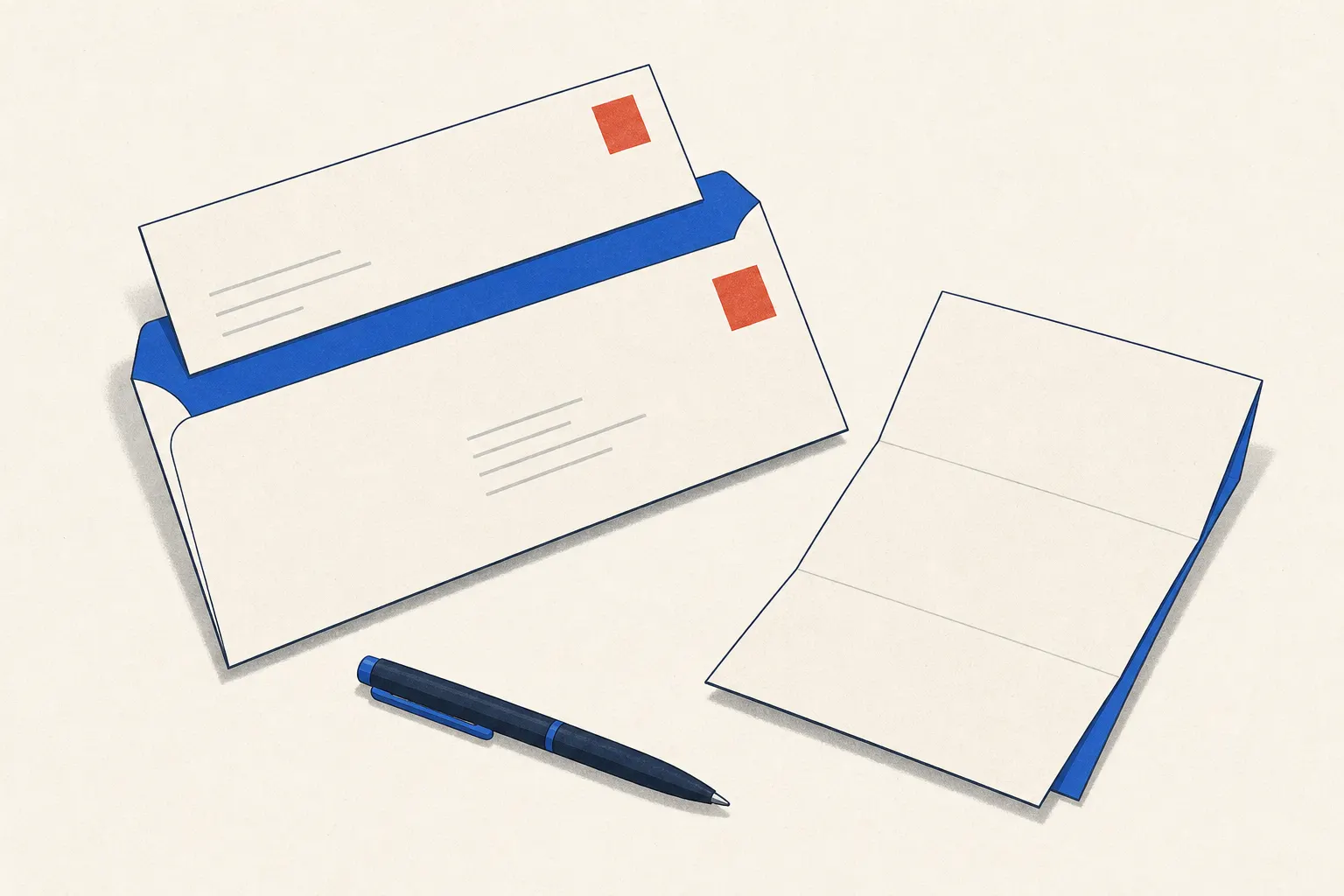
A #9 envelope measures 3⅞ × 8⅞ in (8.875 × 3.875 in, or about 98.4 × 225.4 mm). It’s the standard reply envelope in American business mail: ¼ in lower and ⅝ in shorter than a #10, which is just enough for it to slide inside one without folding.
That small difference is the whole point of the size. This guide covers the exact dimensions, what a #9 holds, how it compares with a #10, and how to address, stamp and print your own reply envelopes at home.
#9 envelope dimensions
USPS sells its own #9 security envelope, and the order form for its Personalized Stamped Envelopes (PS Form 3203-X) gives the size as 3⅞ × 8⅞ in. Windows uses the same numbers for its built-in “#9 Envelope” paper size. As with any envelope, the length is the side the address runs along, so the 8⅞ in edge is the horizontal one.
| Unit | Length × height | Where you’ll need it |
|---|---|---|
| Inches (decimal) | 8.875 × 3.875 | Custom paper sizes in print dialogs |
| Inches (fractions) | 8⅞ × 3⅞ | Envelope boxes, USPS |
| Millimeters | 225.4 × 98.4 | Metric drivers, LibreOffice |
| Points (1/72 in) | 639 × 279 | PDF tools, InDesign, Illustrator |
| Pixels at 300 dpi | 2663 × 1163 | Photoshop, Canva, print-quality artwork |
| Aspect ratio | 2.29 : 1 | USPS machinability check |
The proportions are almost exactly those of a #10 (2.29 against 2.30). A #9 is essentially a #10 shrunk by about 6% in each direction, which is why the two look identical until you hold them side by side.
What a #9 envelope is for
The #9 has one main job: coming back. A business or charity folds its letter into a #10 and tucks a pre-addressed #9 inside, so the reader can return a payment, a form or a donation without hunting for an envelope. That’s an industry convention rather than a postal rule, but it’s what you’ll usually find inside a bill or a donation request.
- Remittance envelopes: a payment slip and a check going back to whoever sent the bill.
- Reply envelopes for paperwork: signed forms, applications, surveys and order forms.
- Donation reply envelopes in fundraising mail.
- Letters on their own: a #9 takes a letter-size sheet folded in thirds, with less room to spare than a #10.
Many #9s, including the one USPS sells, are security envelopes with a tinted pattern printed inside so a check can’t be read through the paper. That makes no difference to printing; the address side is plain.
Some reply envelopes have a window that shows an address printed on the payment slip, so nothing gets printed on the envelope itself. Envelope10 prints directly on the envelope, so use a plain, window-free #9 with it.
#9 vs. #10 side by side
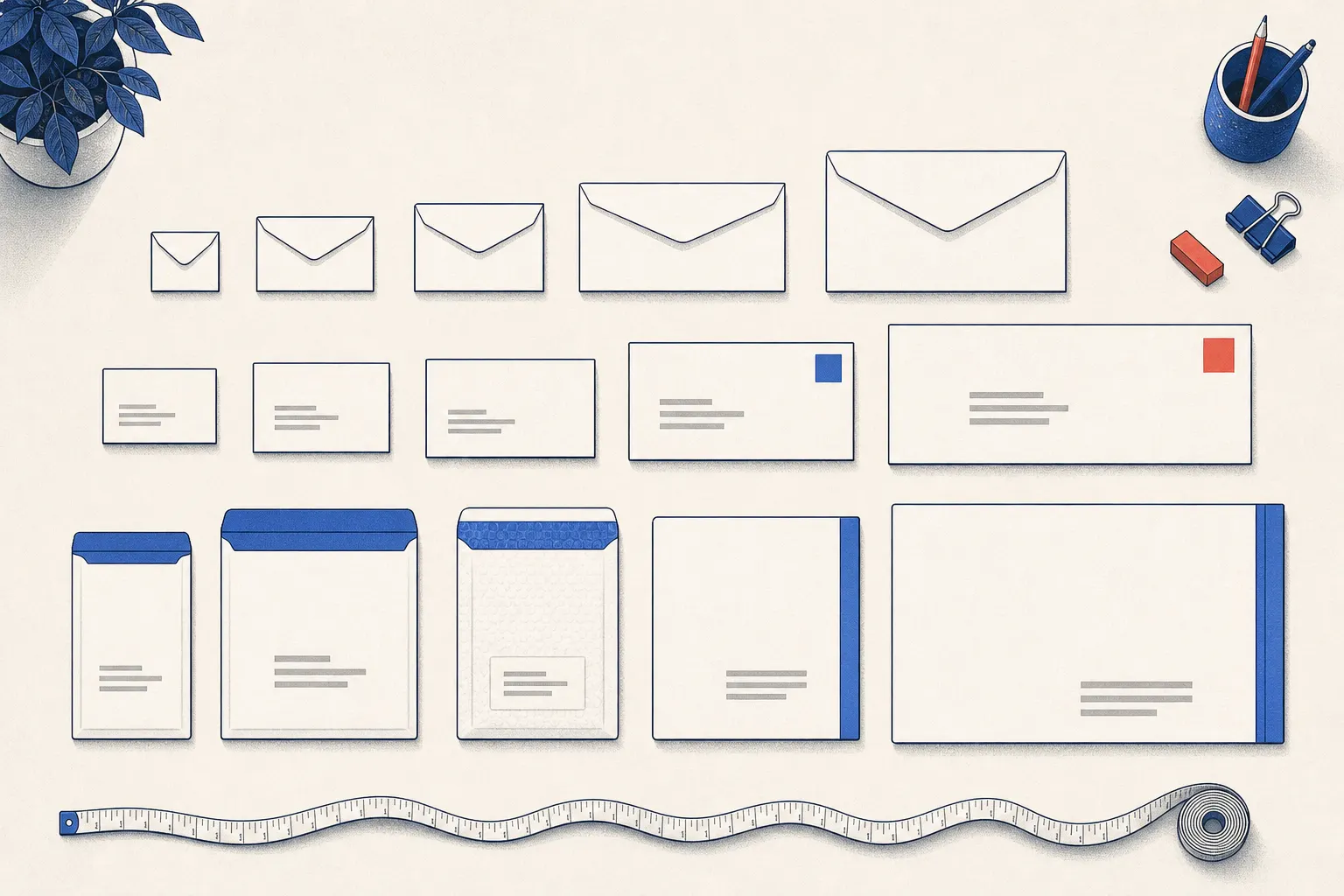
The two sizes are easy to mix up in a supply closet. Here is how they differ, and what each one holds:
| #9 | #10 | |
|---|---|---|
| Size | 3⅞ × 8⅞ in (98.4 × 225.4 mm) | 4⅛ × 9½ in (104.8 × 241.3 mm) |
| Aspect ratio | 2.29 | 2.30 |
| Main job | Reply and remittance envelope | Outgoing letters, bills and statements |
| Letter sheet folded in thirds (about 8½ × 3⅔ in) | Fits snugly: ⅜ in spare in length, about 0.2 in in height | Fits with about 1 in and ½ in to spare |
| A4 sheet folded in thirds (about 8¼ × 3.9 in) | No, taller than the envelope | Yes, snug in height |
| Legal sheet folded in fourths (8½ × 3½ in) | Yes | Yes |
| Personal check or payment slip | Yes | Yes |
| Fits inside the other | Yes, unfolded | No |
| Print-dialog name | Envelope #9 or #9 Envelope, if listed; otherwise custom | Envelope #10 or Com-10 |
| 1 oz postage | $0.82 | $0.82 |
The ¼ in and ⅝ in differences are small, but they’re what make the pair work. Remember that the #10 still has to hold your letter as well: fold the letter in thirds and lay it alongside the #9 rather than wrapping it around. If the outgoing letter runs to several pages, check that everything still closes flat.
Don’t confuse the #9 with a Monarch envelope, either. A Monarch is 3⅞ × 7½ in: the same height, but 1⅜ in shorter, and too short for a tri-folded letter sheet. For every other size and how they relate, see our envelope sizes chart, and for the bigger sibling, the #10 envelope size guide.
Setting up reply mail with a #9
A reply envelope is ordinary mail addressed in reverse: the delivery address is yours, because you’re the one receiving it. Getting it right comes down to three choices.
Address it to yourself
Put your name or business name and mailing address in the delivery block, exactly as you would on any letter. If payments go to a department or a PO box, use that address. USPS asks you to include the ZIP+4 whenever possible, and a reply envelope is a good place to do it, since you’ll be receiving many of them. Our guide on how to address an envelope covers ATTN lines and suite numbers.
Decide what goes in the return address
On most First-Class letters a return address is optional: DMM 202 requires one only in specific circumstances. Envelope10, though, asks for both addresses on every envelope, so you can’t leave it blank. There are two honest ways to fill it:
- The customer’s address, when you’re making a reply envelope for one specific person, such as alongside an invoice. If the reply can’t be delivered, it goes back to them.
- Your own address, when you’re printing reply envelopes for anyone to use. If one can’t be delivered, it simply comes back to you.
Pre-stamp it, or let them stamp it
You can leave the stamp corner empty for the customer, or stamp the envelope yourself to make replying effortless. If you pre-stamp, use a Forever stamp. It’s always worth the current 1 oz First-Class price, so a reply envelope that sits in a drawer through a price change still mails. That last happened on July 12, 2026, when the Forever stamp went from 78¢ to 82¢. Either way, the stamp belongs in the upper right corner of the address side (DMM 604).
Printing a #9 envelope at home
If your printer feeds #10 envelopes, a #9 loads the same way; it’s only slightly smaller. Check your printer’s spec sheet for its supported envelope sizes or custom-size range, then:
- Open the printer with #9 selected. Use this #9 link, or pick #9 with the size buttons above the live preview.
- Enter both addresses. For a reply envelope, your own address goes in the delivery fields.
- Check the preview. Turn on the USPS zones to see the read area and the barcode strip on the smaller envelope.
- Open or download the PDF. The page is exactly 8.875 × 3.875 in, landscape.
- Set the paper size. Choose Envelope #9 if your driver lists it. If not, create a custom size of 8.875 × 3.875 in. On a Mac, choose File › Print, open the Paper Size menu and pick Manage Custom Sizes; on Windows, look for a custom size in the printer’s Preferences.
- Print at 100%. Use Actual size, not Fit to page, so the layout isn’t scaled.
- Load it like a #10. Use the same face-up or face-down and flap direction your printer wants for #10s, and slide the guides in against the narrower envelope. Try one on plain paper first.
The layout is a #10’s, adjusted to the smaller envelope. Because the USPS zones are measured from the bottom and right edges, the barcode clear zone covers more than half of a #9’s bottom edge (4¾ of 8⅞ in), and the delivery block starts ¼ in further left than it does on a #10. If an envelope comes out upside down or on the wrong side, our guide to loading envelopes in HP, Canon, Epson and Brother printers shows how to find the right orientation.
Postage for a #9 envelope
In USPS terms a #9 is a letter, well inside the 11½ × 6⅛ in, ¼ in thick and 3.5 oz limits in DMM 101. Its 2.29 aspect ratio sits inside the 1.3–2.5 range sorting machines accept, so a flat, flexible #9 mails at the regular letter price.
Under USPS Notice 123, in effect since July 12, 2026, that’s $0.82 for 1 oz (one Forever stamp), $1.11 for 2 oz, $1.40 for 3 oz and $1.69 for 3.5 oz. A payment slip and a check make a light letter, so one stamp normally covers a reply; weigh anything thicker.
The nonmachinable surcharge of $0.49 applies if the envelope holds something lumpy, like a key or coins, is too rigid to bend, or has the address running parallel to the short side. For where the address must sit on the front, see USPS address placement rules.
Remember the outgoing side too. The reply envelope adds weight to the #10 it travels in, so if your letter is already several pages long, weigh the full packet before you stamp it. Mailing checks in a smaller envelope instead? Our #6¾ envelope size guide covers that size, and you can print your next #9 here.
Frequently asked questions
What size is a #9 envelope?
A #9 envelope is 3 7/8 x 8 7/8 in, or 8.875 x 3.875 in, which is about 98.4 x 225.4 mm. In points it is 639 x 279 pt.
What is the difference between a #9 and a #10 envelope?
A #10 is 4 1/8 x 9 1/2 in, so a #9 is 1/4 in lower and 5/8 in shorter. The two have almost the same proportions, but the #9 is small enough to travel inside a #10, which is why it is the usual reply envelope.
Does a #9 envelope fit inside a #10?
Yes, flat and unfolded. That is the main reason the size is used: you fold your letter into the #10 and include a pre-addressed #9 so the reader can mail something back.
What fits in a #9 envelope?
A letter-size sheet folded in thirds fits, though snugly, as do a personal check, a payment slip and a legal sheet folded in fourths. An A4 sheet folded in thirds is about 3.9 in tall and will not fit.
Is a #9 envelope the same as a Monarch envelope?
No. A Monarch envelope is 3 7/8 x 7 1/2 in: the same height as a #9 but 1 3/8 in shorter. Monarchs are usually paired with smaller personal stationery, while a #9 takes a tri-folded letter sheet.
How many stamps does a #9 envelope need?
One Forever stamp covers a #9 letter up to 1 oz ($0.82 as of October 2026). Each extra ounce up to 3.5 oz adds $0.29, and a nonmachinable letter, for example one with a coin or key inside, adds $0.49.